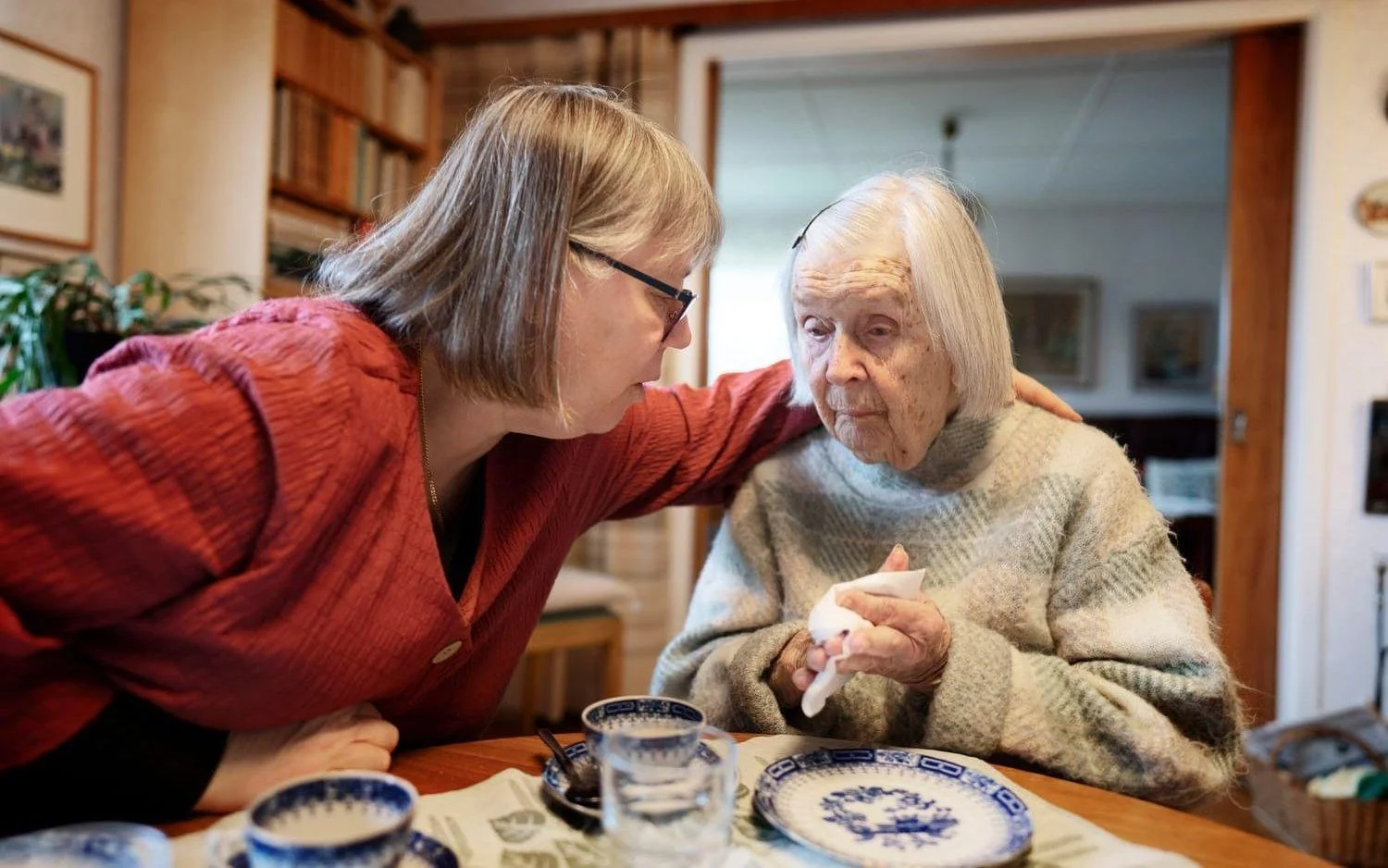
Perspectives // Ageing in Place
Caring till we Drop.
The Weaponisation of Devotion
Could an invisible, largely unmeasurable human force be helping to sustain the Ageing in Place transition?
By DAVID STUART BATHE
2026
This Perspective grew out of a correspondence with Dr Mariam Kirvalidze and Dr Amaia Calderón-Larrañaga at Karolinska Institutet, following their research into the intensity of informal caregiving among older people in Sweden.
Their 2025 study, The intensity of informal caregiving and its implications for older caregivers, explored what happens as the intensity of informal caregiving increases.
But our conversation left me with another question.
If caring is beginning to cost some people so much, what is it that makes them keep going?
Ageing in Place
Ageing in Place presents us with an appealing picture.
Growing older in our own homes. Remaining surrounded by familiar things, familiar people and familiar places. Preserving independence, dignity and connection for as long as possible.
There are compelling human reasons for wanting that.
But behind the front door, another story may be unfolding.
Research from Karolinska Institutet and colleagues examining older informal caregivers in Sweden found a clear relationship between the intensity of caregiving and its consequences:
Those providing 30 hours or more of care each week reported greater psychological strain, sleep problems, difficulty maintaining friendships and unmet support needs than those providing lower levels of care.
And yet something else is striking:
The caring continues.
But the research leaves us with another question:
Why?
Why does someone continue giving care when doing so is beginning to damage their own life?
Perhaps because we have been looking at caregiving primarily as a question of capacity, without asking what might be driving that capacity in the first place.
What if some of the capacity we think we're seeing is actually devotion?
Devotion, the invisible subsidy
A daughter doesn't necessarily care for her mother because she has twenty hours available that week.
A husband doesn't get up for the fourth time during the night because his remaining care capacity has been calculated and found sufficient.
They do it because of the relationship between them:
Because it's Mum.
Because it's the person they have shared their life with.
Because somebody is frightened.
Because somebody needs them.
Because walking away doesn't feel like an option.
That is not ordinary capacity.
It is devotion.
And devotion is a peculiar resource for any system to become dependent upon.
It cannot be commissioned.
It cannot be scheduled.
It cannot be mandated.
It cannot be guaranteed.
It cannot simply be replenished.
Most importantly:
it has no obvious limit.
Someone providing a formal service can say:
My shift is over.
A municipality can say:
You do not meet the criteria.
But a devoted husband whose wife is in pain at two in the morning cannot so easily say:
I've reached my allocated capacity.
The formal service ends.
The relationship remains.
A professional can finish a shift, change jobs or eventually leave the profession.
A daughter cannot resign from being a daughter.
And perhaps that is where something deeply human, begins to become something the system can quietly depend upon.
When devotion becomes capacity
Devotion has an extraordinary ability to create apparent capacity. No contracts, no agreements.
People find another hour.
They cancel something.
They sleep a little less.
They stop seeing somebody.
They postpone their own appointment.
They work fewer hours.
They become the coordinator, driver, advocate, cook, companion, administrator and night watchman.
They find a way.
And because they find a way, the arrangement continues to function.
Mum remains at home.
Dad gets his medication.
The appointment is made.
The shopping appears at a neighbour’s door.
The confusion is managed.
Appointments are kept.
Another night passes.
Another week is held together.
From outside the home, the outcome can look remarkably like success.
The system sees the outcome. It may not see what the person gave up to make that outcome possible.
That distinction matters.
Because when devotion repeatedly creates capacity that would otherwise not exist, extraordinary human effort can gradually become ordinary system expectation.
What people will do starts to look like what people can do.
And what people appear able to do can eventually become what a system assumes they will continue to do.
If we mistake devotion for capacity, we may also mistake endurance for sustainability.
Devotion becomes capacity.
Capacity becomes assumption.
Assumption becomes dependency.
And that is where we encounter a much more uncomfortable possibility.
The weaponisation of devotion
Nobody needs to deliberately exploit a family caregiver for exploitation to occur.
There does not need to be a policy document somewhere saying:
Families will fill the gaps.
It can happen much more quietly.
Formal capacity becomes constrained.
People compensate.
Gaps are filled.
The arrangement carries.
And the system learns that it can continue.
The peculiar power of devotion is that nobody needs to enforce it.
Nobody has to tell the daughter to keep going.
Her mother needs her.
Nobody has to force the husband out of bed.
His wife is calling.
Nobody has to allocate the neighbour another visit.
He knows nobody else is coming.
The system doesn't create that obligation.
The relationship does.
But the system can still benefit from it.
That is what we might call the weaponisation of devotion.
Not the deliberate weaponisation of love by individual doctors, nurses, municipalities or policymakers.
It’s something far subtler.
A system gradually becoming dependent upon people's unwillingness to abandon someone they care about.
And that raises a deeply uncomfortable question:
What happens when our systems begin to budget for devotion?
Nobody writes devotion: 20 hours into a municipal spreadsheet.
But if a policy can only work because families continue to absorb whatever lies beyond formal provision, are we not effectively doing exactly that?
The invisible metric
The difficulty is that devotion doesn't behave like an ordinary economic resource.
We can measure hours.
We can estimate the economic value of unpaid care.
We can measure service utilisation.
We can record sick leave.
We can measure psychological distress, sleep disruption and health outcomes.
But we cannot easily measure:
How much more will this person give because they love somebody?
There is no dashboard showing:
Devotion remaining: 36%.
No warning light saying:
Emotional reserve approaching critical level.
No reliable calculation telling us how many more interrupted nights a 76-year-old husband can sustain because his wife has dementia.
The limit is invisible.
And devotion itself can help conceal it.
Because devoted people don't necessarily stop when they reach their sustainable capacity.
They continue.
Something else gives way instead.
Sleep.
Friendships.
Exercise.
Work.
Patience.
Their own appointments.
Their own needs.
Sometimes their own health.
The care hasn't disappeared. Other parts of the caregiver's life have.
The cracks may remain hidden precisely because devotion keeps filling them.
Until it can't.
Caring till we drop
This is where an apparently emotional idea becomes a medical one.
Chronic caregiving stress does not necessarily remain psychological.
Prolonged stress can become physiological.
Sleep disruption, sustained vigilance, physical demands and chronic emotional strain can accumulate in the body.
Researchers describe one way of understanding this cumulative biological burden as:
allostatic load.
Put simply, the body pays for continually adapting to stress.
This in-turn, creates an extraordinary paradox at the heart of Ageing in Place:
In trying to preserve one person's health and independence at home, we may gradually consume the health and independence of the person making it possible.
Which raises another uncomfortable question:
Are we creating the secondary patient?
If keeping one person healthy and independent at home gradually compromises the health and independence of the person making it possible, have we really reduced demand on the healthcare system, or merely transferred it?
The system receives the capacity now. It may receive the healthcare consequences later.
That is the real meaning of Caring Till We Drop.
Not that caring is harmful.
Not that families shouldn't care.
And certainly not that devotion itself is the problem.
Quite the opposite.
The problem may be that devotion works too well.
It works quietly. It fills the gaps. It absorbs the pressure. And it can keep working long after the arrangement itself has ceased to be sustainable.
It keeps people going.
It keeps families functioning.
It keeps people at home.
The danger isn't that devotion fails. The danger is how long it can succeed.
What formal care cannot provide
There is another mismatch here.
Formal care is necessarily bounded.
It has working hours, responsibilities, eligibility criteria, budgets, professional boundaries and tasks.
Devotion doesn't.
Formal care can:
Administer medication.
Help someone wash.
Prepare food.
Change a dressing.
Assess a clinical need.
But human life doesn't divide itself neatly into tasks.
There is also the confusion.
The fear.
The loneliness.
The repeated question.
The noise downstairs at three in the morning.
The feeling that something isn't quite right.
The need for reassurance.
The need for somebody simply to be there.
Formal care deals remarkably well with many needs that can be specified.
Devotion often fills the spaces between them.
We can measure the formal intervention.
We struggle to measure everything surrounding it.
Home has a hidden infrastructure
This also reveals something important about the idea of home itself.
We want older people to remain at home partly because home can provide things an institution cannot easily reproduce.
Familiarity.
Identity.
Continuity.
Belonging.
Intimacy.
Safety.
Perhaps even sanctuary.
But sanctuary doesn't maintain itself.
Someone has to help sustain it.
And increasingly, that someone may be a husband, wife, daughter, son, friend or neighbour.
Which means that some of the very qualities that make home such an attractive alternative to institutional care may depend upon human relationships that the formal system neither creates nor controls.
We want what those relationships provide.
But are we beginning to treat the people within them as though they were part of the infrastructure?
That is a very different question from whether families should help care for one another.
Of course they will.
People have always cared for people they love.
The question is whether a modern welfare system can safely design around the assumption that they always will. Whatever the cost.
From caregiver to care unit
Perhaps this suggests that we are looking at the wrong unit.
Ageing in Place naturally focuses attention on the person ageing at home.
What services do they need?
What technology?
What adaptations?
What medical support?
What will enable them to remain independent?
But independence can be deceptive.
A daughter organising appointments.
A husband watching through the night.
A neighbour collecting groceries.
A son dealing with digital services.
Someone remembering.
Someone anticipating.
Someone worrying.
Someone always being available.
So perhaps the real unit isn't simply the person receiving care.
Perhaps it’s the care relationship surrounding them.
And if that relationship breaks, much of the apparent independence can disappear with it.
That changes the design question.
Instead of asking only:
How do we enable this person to remain at home?
Perhaps we also need to ask:
What does the person making that possible need in order to remain well?
Not because supporting caregivers sits alongside Ageing in Place.
Because their capacity may already be part of the architecture upon which Ageing in Place depends.
Protect the devotion
This leads to an important distinction.
The answer cannot be to make devotion more efficient.
We should not try to extract another five percent from the daughter.
Optimise the husband.
Improve the productivity of the neighbour.
Turn love into a better-performing component of the welfare system.
Devotion isn't ours to optimise.
The design challenge is almost the opposite.
Protect it.
Reduce the unnecessary demands surrounding it.
Remove avoidable coordination.
Reduce fragmentation.
Make information easier to share.
Make responsibilities clearer.
Create continuity around the person being cared for.
Allow several people to carry what one person may currently be carrying alone.
In other words:
Don't design devotion into the system.
Design the system to take care of everything else, so devotion doesn't have to.
Because Ageing in Place may ultimately depend upon hospitals, municipalities, healthcare professionals, technology, housing and public money.
But underneath all of those visible structures may sit another form of infrastructure entirely.
People who care enough to keep finding a way.
That is something worth protecting.
Not because devotion is weak.
Because it is extraordinarily strong.
Strong enough to conceal failing capacity.
Strong enough to absorb missing services.
Strong enough to keep an unsustainable arrangement functioning long after conventional resources would have run out.
And perhaps strong enough for us to mistake its continued presence for evidence that the system itself is working.
So before we ask families to carry more of the Ageing in Place transition, there is one question we should perhaps ask first:
What happens when something designed as a system begins to depend upon something that cannot itself be systematised?
Research informing this Perspective
Kirvalidze, M., Hanson, E., Magnusson, L., Dahlberg, L., Wimo, A., Morin, L. & Calderón-Larrañaga, A. (2025). The intensity of informal caregiving and its implications for older caregivers: a national survey in Sweden. Scandinavian Journal of Public Health. DOI: 10.1177/14034948251335113.
This Perspective also draws on correspondence with Dr Mariam Kirvalidze and Dr Amaia Calderón-Larrañaga at Karolinska Institutet concerning the findings and their implications for informal caregiving.
Sketch Picture: Robin Aron / Gothenburgs-Posten: Hemtjänsten kommer till Berit med motorbåt varje natt Published 2025-02-06
About the author
David Bathe is the founder of WEAREONEWORLD. After more than four decades working across communication and designed solutions, his focus has shifted towards the societal changes reshaping everyday life. His work explores the changing relationship between people, systems and technology, and how creative thinking can help us recognise and understand emerging challenges before we rush to solve them.