Perspectives // Ageing in Place
When Healthcare Moves Home
At what point does “home-based care” stop simply describing where a patient receives healthcare and start describing a transformation imposed upon everyone living there?
By DAVID STUART BATHE
2026
This Perspective began with a conversation with Dr. Maria Nilsson at Linnaeus University in Sweden, whose research explores older people, informal care and the role of digital technology.
We had originally connected through her paper, Keeping the older population and their informal carers healthy and independent using digital technology.
Our conversation quickly moved beyond technology to a much simpler question: as more care moves into the home, does it necessarily work to the advantage of everyone living there?
That conversation prompted a question worth exploring:
Are we really “designing” the transition, or simply letting it take shape?
The Home as infrastructure
There is something inherently appealing about the idea of being cared for at home.
For older people: It means remaining in familiar surroundings instead of an institution
For recovering patients: It means leaving the hospital earlier
For the healthcare system: It means more monitoring, rehabilitation, treatment and complex care can take place outside an institution
The move towards more home-based care sounds like progress, and in many ways it is. But perhaps we are describing this change too narrowly. When a health system moves into the home, it isn't only healthcare that moves in.
Equipment and technology move in
Monitoring and coordination move in
Responsibility and expectations move in
Risk and potential failure move in
Suffering moves in
And inevitably,
the work previously contained behind closed doors within an institution, moves in too.
The transition isn't happening only to the patient.
It's happening to the household.
The contradiction
When a home becomes part of the healthcare system, we encounter a simple but important contradiction:
a hospital is designed around illness
a home isn't
A hospital has space for equipment, systems for monitoring, and designated spaces for various degrees of sickness. When something goes wrong, whether with the patient, the equipment or the technology, professionals are available within an environment designed to respond.
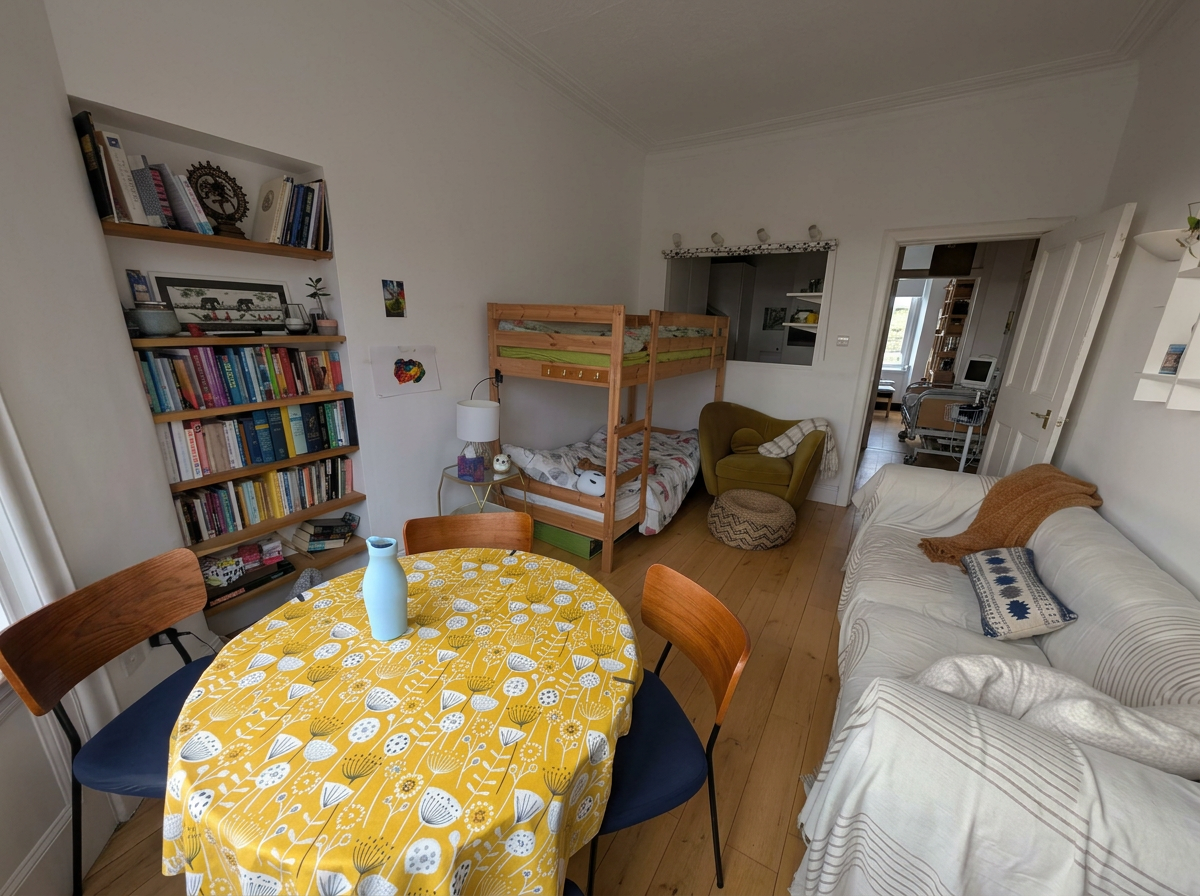
A home on the other hand, is designed for something else entirely: dinners, entertainment, children doing homework, partners sleeping, neighbours visiting, laundry waiting to be done and people trying to continue ordinary lives.
But a home is also something less tangible:
A sanctuary.
When someone we love is seriously ill in the hospital, we can visit them for a few hours and then return home. The illness doesn't disappear, but the clinical environment does.
When the hospital moves into the home, it dilutes that opportunity for sanctuary.
A large home can absorb it; a small apartment cannot.
Moving healthcare into the home is one thing. But designing healthcare for the home may be something we’ve overlooked.
The problem of context
A household with a large home, financial resources, flexible employment, and a strong family network can absorb a hospital bed, medical equipment, visiting professionals, and additional responsibilities without fundamentally unbalancing their lives.
But what happens in a two-room apartment, to a single-parent family?
What if the other person living there is a teenager?
What happens when a brief period of treatment becomes months of treatment?
What happens when treatment becomes end-of-life care?
These aren't hypothetical questions. During our conversation, Maria described a case remarkably similar to this.
And the capacity of a household isn't only about space or financial resources. It can also depend on the people available to make care at home work.
The independence paradox
Technology and digital independence present an interesting contradiction. A monitor, sensor, or digital service may allow someone to remain at home independently for longer.
But exactly how independent is that independence?
A sensor needs installing
A device needs configuring
A battery needs charging
Connections fail
Alerts need interpreting
At that moment, independent technology reveals its weak spot:
it requires a person.
Someone to notice
Someone to respond
Someone to repair or replace
The technology may increase a person's apparent independence while simultaneously increasing their actual dependence upon an invisible human infrastructure. Sometimes that person is a healthcare professional, the municipality, or a private service provider.
And often, it may simply be whoever happens to be nearby: a husband, wife, daughter, son, friend, or neighbour.
When we calculate the efficiency and independence created by technology, are we also calculating the human capacity required to make that independence possible?
Perhaps we've designed the technology.
But have we designed for the human capacity required around it?
They may not appear in caregiver data because they aren't caregivers. But the transition is happening to them too.
Are we looking at the wrong unit?
Healthcare naturally focuses on the patient. Caregiver research has widened that picture by showing what happens to the people providing informal care.
But even "patient + caregiver" is sometimes too small a unit through which to understand care at home. There may be other people in the household who provide little or no care at all, yet they are living inside the consequences of it:
A child who can no longer bring friends home
A teenager trying to study beside medical equipment
A partner whose home gradually becomes organised around treatment
A family living for months with professionals entering and leaving what was previously their private space
They may never appear in healthcare data because they aren't patients. They may not appear in caregiver data because they aren't caregivers. But the transition is happening to them too.
Perhaps the relevant unit isn't only the patient. Perhaps it’s the household.
Which raises a simple design question:
Who exactly are we designing care at home for?
And then there is equity
Once the home becomes part of the healthcare infrastructure, housing itself becomes a healthcare issue. So does income, geography, family structure, employment flexibility, and the availability of another human being willing and able to help.
The same healthcare policy may therefore produce profoundly different experiences depending upon the household into which it arrives.
This presents an awkward possibility: the move towards home-based care, designed to make healthcare more sustainable and accessible, could make a family's existing social and economic circumstances a predominant factor in how successfully that care can be accommodated by the household.
The hospital provides roughly the same room regardless of the size of your house.
Healthcare at home doesn't.
If the home is becoming part of the healthcare infrastructure, perhaps the differences between homes, need to become part of the design brief too.
A bigger transition
We have been exploring what we call The Ageing in Place Transition: the movement toward enabling more people to remain independent and supported within their own homes as they grow older.
But perhaps Ageing in Place is one visible part of something larger:
We aren't merely moving healthcare into the home. We are redistributing functions that once belonged within institutions across homes, families, technology and communities.
Treatment moves. Monitoring moves. Technology moves. But so do coordination, responsibility, risk and work.
Some of this will be absorbed by healthcare services, technology, municipalities and private providers. The rest may fall to families, friends and communities.
None of it disappears. It simply arrives somewhere else.
The individual solutions making this transformation possible can be extraordinary. Enormous creative, technological, and financial resources are being invested in the digital transformation of healthcare. The resulting products and services are often beautifully designed solutions to monitoring, communication, treatment, diagnosis, and independence.
They are not the problem. They are part of an evolution in healthcare practice, and a technological revolution that makes it increasingly possible for care, once delivered within an institution, to be delivered at home.
But perhaps this is where the real design challenge begins:
We can't solve a system problem simply by accumulating individual solutions.
Each solution may work perfectly on its own. But collectively, they are enabling something much larger:
the home itself is becoming part of the healthcare system. And that is more than a change of location.
We cannot simply take a healthcare model designed around institutions, replace the institution with the home, and expect everything else to remain unchanged. The home is a fundamentally different environment.
We can integrate the technologies, connect the data, and make the individual components work together. But that integration doesn't address what happens when all of those solutions arrive in somebody's home.
Who coordinates them?
Who responds when something fails?
Who provides the time and attention they require?
What happens to everyone else living there?
What happens when the household doesn't have the capacity the system assumes it does?
Integration can make the technologies work together. It doesn't necessarily make the system work for the people living within it.
Perhaps we've become very good at designing the individual pieces. What we haven't yet designed is what they collectively create. Perhaps that is the transition we are actually witnessing.
And that leaves us with the elephant in the room:
If the home is becoming part of the healthcare system, surely the household needs to become part of the design brief too.
Research informing this Perspective
Nilsson, M., Andersson, S., Magnusson, L. & Hanson, E. (2024). Keeping the older population and their informal carers healthy and independent using digital technology: a discourse analysis of local policy. Ageing & Society, 44(4), 812–842. DOI: 10.1017/S0144686X22000514.
This Perspective also draws on a conversation with Dr Maria Nilsson at Linnaeus University concerning the research and the wider implications of moving healthcare and care into the home.
About the author
David Bathe is the founder of WEAREONEWORLD. After more than four decades working across communication and designed solutions, his focus has shifted towards the societal changes reshaping everyday life. His work explores the changing relationship between people, systems and technology, and how creative thinking can help us recognise and understand emerging challenges before we rush to solve them.